
Most welding shop managers approach air quality the same way: check the compliance box, install a fume extractor that meets regulatory minimums, and assume the problem is solved. But compliance and actual air quality are two different things. A system can technically pass inspection while workers breathe air that wears on their health, reduces productivity, and creates liability that extends far beyond what a regulatory audit will catch.
The real question isn’t whether your shop meets the baseline standard. It’s whether your extraction strategy actually protects your team and keeps your operation running at peak efficiency. Understanding welding ventilation systems means recognizing where compliance ends and operational reality begins.
Key Takeaways
- Regulatory compliance and actual worker safety are not synonymous in welding fume management.
- Many shops meet minimum standards while still operating with suboptimal air quality that affects worker performance and long-term health.
- Effective fume control depends on matching extraction type and capacity to your specific welding processes and shop layout, not just regulatory thresholds.
- Regular monitoring and maintenance reveal air quality gaps that compliance checklists alone will not catch.
Why It Matters
Welding produces a complex mixture of metal oxides, gases, and particulate matter that accumulates in the breathing zone even when it’s not visibly thick in the air. A shop that operates within OSHA guidelines but relies on passive ventilation or undersized extraction can still expose workers to cumulative fume loads that regulatory thresholds don’t fully account for. This creates a hidden cost: reduced worker focus, fatigue, respiratory stress, and turnover that shop owners often attribute to other factors.
The second issue is operational. A poorly designed extraction system forces workers to position themselves awkwardly to keep fumes out of their breathing zone, slowing work and increasing defects. It can also pull cool air unevenly across the shop floor, creating dead zones where smoke hangs. These aren’t compliance violations; they’re efficiency killers that show up as slower production cycles and higher scrap rates.
The third factor is liability. If a worker develops a respiratory condition and your shop’s air quality records are thin or reactive rather than proactive, your ability to demonstrate you prioritized air quality becomes a legal liability. Shops that measure, document, and actively manage fume levels build a record that shows intent and effort, not just box-checking.
The Gap Between Compliance and Operational Reality
Compliance standards exist for a reason, but they set a floor, not a ceiling. OSHA’s Permissible Exposure Limit (PEL) for welding fume is 5 mg/m³, but this threshold was established decades ago and reflects what was considered acceptable at the time, not what modern research suggests is optimal for worker health and productivity.
Many welding processes generate fume loads that hover just below the PEL when measured at specific points during a compliance audit. But workers don’t spend eight hours standing in one exact spot. They move around the shop, position themselves at different angles to the weld joint, and experience variable fume concentrations throughout the day. A system that barely meets the standard at the measurement point often fails to protect workers in realistic working conditions.
Another gap appears when shops rely on general ventilation alone. An HVAC system that exchanges room air at a compliant rate may satisfy the standard but cannot effectively capture welding fume at the source. The fume gets drawn into the general air stream, dispersed throughout the shop, and then exhausted. This means fume spends more time in the worker’s breathing zone before it exits, and other workers in the shop experience secondary exposure.
Source Capture vs. General Ventilation
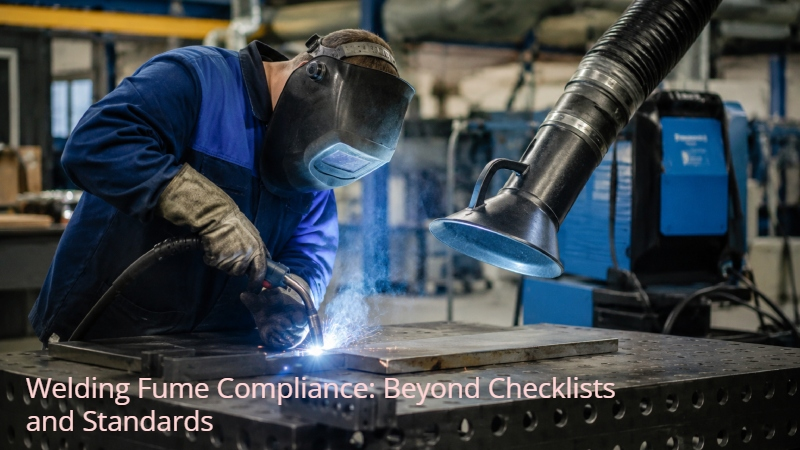
The most effective approach isolates fume at the weld itself rather than trying to clean the entire shop air. Source capture systems, whether portable gun-mounted extractors or fixed fume arms, remove fume before it spreads. This strategy offers three advantages that compliance-only thinking overlooks.
First, source capture dramatically reduces the fume load any single worker encounters. A shop with a 5,000 CFM extraction arm positioned at the weld joint removes 80 to 90 percent of fume before it reaches the worker’s face, compared to a general ventilation system that removes perhaps 40 to 60 percent after dispersion. The difference in cumulative exposure over a shift is substantial.
Second, source capture allows shops to use appropriately sized systems for their actual process mix. A small fabrication job doesn’t require massive general ventilation; a portable extractor handles it. A high-volume MIG line benefits from a fixed extraction point. Matching the system to the work means less energy waste and better performance across varied jobs.
Third, source capture creates a measurable baseline. When you extract at the source, you know exactly how much air you’re moving and how much fume is being captured. General ventilation is harder to verify and easier to disrupt by open doors, layout changes, and seasonal air pressure differences.
Monitoring and Maintenance: The Overlooked Compliance Layer
A system installed correctly but maintained poorly becomes a compliance liability. Filters clog, pickup arms accumulate dust, and flexible hoses develop leaks or kinks. Shops that meet the compliance checkbox at installation often discover six months later that their extraction capacity has degraded 20 to 30 percent. They’re still within the standard, but barely, and the safety margin has vanished.
Proactive shops establish a maintenance schedule tied to their specific work volume and process types. High-heat processes like stick welding load filters faster than low-heat MIG work. Stainless steel generates different fume densities than mild steel. A shop that welds stainless steel all day may need filter changes every month, while a mild steel shop might go quarterly. Guessing or following a one-size-fits-all schedule defeats the point.
The second maintenance layer is system verification. Once a quarter, a shop should check extraction velocity at the source using a simple anemometer. If the velocity has dropped below design specs, you know maintenance is needed before fume exposure increases. This isn’t a regulatory requirement, but it’s the difference between meeting the standard and actually protecting workers.
A Practical Scenario: The Mid-Sized Fabrication Shop
Consider a 20-person welding job shop that primarily performs structural steel and custom brackets. They installed a general ventilation upgrade five years ago that brought them into OSHA compliance. Windows have louvers, roof exhaust fans run all day, and the shop passed inspection. But over the past two years, three experienced welders have left for positions at other shops, citing respiratory irritation and fatigue. Two newer hires are struggling to hit quality standards. The shop manager sees turnover and assumes it’s a wage or culture issue.
What’s actually happening: the general ventilation system is adequate on paper but fails during peak work. When three or four jobs are running simultaneously, fume disperses throughout the 4,000 square foot space faster than the ventilation can handle it. Workers in the back of the shop experience secondary exposure. The experienced welders, who work longer hours, accumulated respiratory stress that pushed them to look elsewhere. New hires don’t have the physical tolerance to work comfortably in that environment.
The fix isn’t another compliance audit. It’s adding source capture to the three busiest welding stations. A combination of fixed extraction arms for the main welding line and a portable unit for job-specific work reduces the ambient fume load by 60 percent. Compliance is maintained; worker experience and quality improve dramatically. This shop now has a retention advantage and measurable data showing it invests in air quality beyond the minimum.
Designing an Air Quality Strategy Beyond Compliance
Start with process mapping. What percentage of your work is done in a fixed location versus at various points in the shop? Which processes generate the heaviest fume loads? How long do your team members typically spend at each station? These questions determine whether you need fixed systems, portable systems, or a hybrid approach.
Next, assess airflow patterns. Bring in a simple smoke test to see how air actually moves in your space under normal working conditions. You may find dead zones, backdrafts, or interference patterns that regulatory audits never check. This visual confirmation often reveals why compliance exists on paper but feels wrong on the floor.
Third, establish a filter replacement protocol tied to visual and performance indicators, not just a calendar. Check filter resistance regularly and replace before efficiency drops below 80 percent of design specs. Document every replacement to build a record that shows continuous attention to air quality.
Finally, commit to quarterly or semi-annual spot measurements of fume concentration at various points in the shop during actual work. You don’t need expensive equipment; a basic particulate monitor is affordable and provides data that shows whether your system is performing as designed. This documentation becomes invaluable if questions ever arise.
Actionable Takeaways
- Schedule a walk-through of your shop’s extraction system with a focus on actual working conditions, not just compliance criteria. Observe worker positioning, identify potential exposure hotspots, and note any visible fume escape.
- Test airflow patterns in your space using a simple smoke stick or portable anemometer to verify that air moves as designed. Look for dead zones and areas where fume hangs longer than expected.
- Establish a filter maintenance schedule based on your specific welding processes and work volume. Check filters monthly and replace them before resistance increases beyond design limits.
- Implement quarterly verification of extraction velocity at source points. Declining velocity signals maintenance needs before exposure increases.
- Document all maintenance, filter changes, and air quality observations. This record demonstrates that your shop prioritizes air quality beyond compliance and protects you if questions arise.
- Evaluate whether your current general ventilation can handle peak simultaneous welding loads, or whether adding source capture at high-traffic stations would improve both compliance margin and worker comfort.
Conclusion
Welding fume compliance is necessary but insufficient. A shop that meets regulatory standards while operating with marginal air quality is taking on unnecessary risk: worker health issues, hidden turnover costs, quality problems, and potential liability if conditions are ever questioned. The difference between checking the box and actually protecting your team is a systematic approach that goes beyond the minimum, measures what matters, and adjusts based on real-world performance rather than assumptions. Shops that do this build safer operations, reduce turnover, improve quality, and create a record that shows genuine commitment to worker safety. That’s the real value of moving past compliance and into genuine air quality management.
FAQ
What is the difference between OSHA compliance and effective fume control?
OSHA compliance means your shop meets the legal minimum standard for air quality. Effective fume control means your workers actually experience good air quality in their breathing zone during normal work. A shop can pass compliance while still exposing workers to cumulative fume loads that affect their health and performance because the standard was set decades ago and doesn’t account for individual variation in work positioning and cumulative daily exposure.
How often should I test or replace filters in my extraction system?
Filter replacement depends on your welding process volume and type. High-volume or high-heat processes like stick welding may require monthly changes, while lower-volume mild steel work might go quarterly. The best approach is to check filters visually every month and replace them when resistance increases noticeably or when extraction velocity drops below design specs, rather than following a rigid calendar schedule.
Can general ventilation alone meet air quality needs in a welding shop?
General ventilation can achieve OSHA compliance for many shops, but it is less effective than source capture for protecting workers in their breathing zone. General systems disperse fume throughout the shop before exhausting it, which means workers experience longer exposure periods and secondary exposure occurs across the entire space. Source capture at the welding point removes 80 to 90 percent of fume before it spreads, providing better protection with less overall air movement.
What should I look for to identify air quality problems before they become serious?
Watch for visible fume that lingers in specific areas, even with ventilation running. Listen to worker feedback about respiratory irritation or fatigue, especially from experienced welders who know what conditions should feel like. Check extraction velocity at source points using a simple anemometer to verify the system is performing at design specs. A decline in velocity indicates maintenance is needed. If you notice higher turnover among experienced welders or quality issues that seem tied to fatigue, air quality may be the underlying factor.
Is it worth upgrading to source capture if my shop currently meets compliance with general ventilation?
It depends on your specific situation, but many shops find the investment worth it because of improved worker retention, better quality, and lower operational strain. Source capture systems cost less to operate than large general ventilation systems, perform better in the worker’s breathing zone, and provide measurable performance data. If your current system barely meets compliance or if you are seeing turnover, quality issues, or worker complaints about air quality, upgrading to source capture often pays for itself through improved efficiency and retention within one to two years.
How do I document air quality management to protect my shop liability-wise?
Maintain a log of all filter replacements, maintenance work, and any monitoring or spot measurements you perform. Document when velocity checks show system performance is declining and what corrective action you took. If you conduct spot measurements of fume concentration, record the results and location. This documentation demonstrates that your shop prioritizes air quality proactively and continuously, not just at compliance checkpoints. If a worker later claims a respiratory condition, your records show you took deliberate steps to manage exposure.