
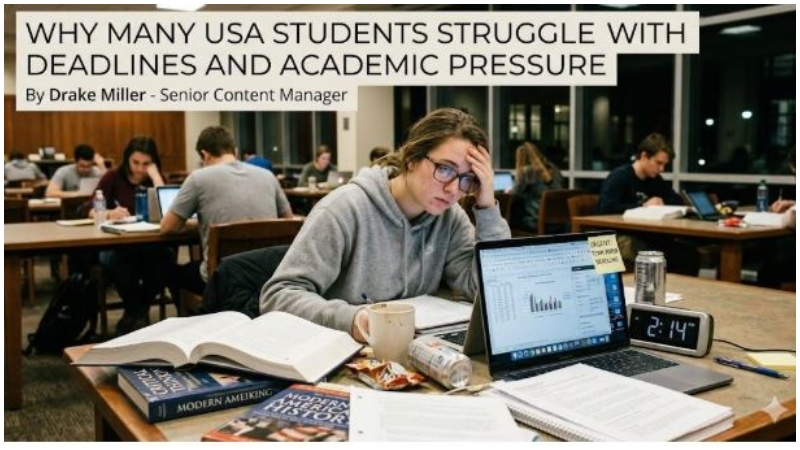
In the competitive landscape of American education—stretching from the high-stakes environment of AP-heavy high schools to the rigorous demands of Ivy League universities—a quiet crisis is unfolding. Students are not just “busy”; they are drowning in a convergence of rising academic expectations, hyper-competitive extracurricular commitments, and a shifting digital landscape that fragments their focus.
Understanding why many students in the USA struggle with deadlines and academic pressure requires looking beyond the surface-level critique of “poor time management.” It necessitates an exploration of the structural, psychological, and technological factors defining the modern student experience in 2026. From the “Junior Year Crunch” to the “AI-Academic Paradox,” the hurdles have never been higher.
1. The “Performance Trap” and High-Stakes Testing
In the United States, the path to success is often framed through a narrow lens of high-stakes assessments. For high schoolers, the pressure to maintain a perfect GPA while scoring in the top percentiles of the SAT or ACT—even in its digital-first evolution—creates a “perpetual crunch time.” This is especially visible during the junior year, where students must juggle advanced coursework—often requiring specialized Android assignment help for technical modules—with the looming reality of college applications and scholarship deadlines.
This “performance trap” suggests that a student’s worth is tied directly to their quantifiable output. When every assignment feels like a make-or-break moment, the psychological weight can lead to “analysis paralysis.” Instead of starting a project, students become so intimidated by the need for perfection that they delay the task. This isn’t laziness; it is a sophisticated defense mechanism against the fear of failure. In 2026, as university acceptance rates at top-tier institutions hit record lows, this anxiety has permeated even the most resilient student cohorts.
2. The Extracurricular Overload and the “Common App” Standard
The “well-rounded student” ideal has become an exhausting, and perhaps impossible, standard. To be competitive for elite USA universities, students feel compelled to lead multiple clubs, play a varsity sport, and clock hundreds of volunteer hours—all while taking a full load of honors or dual-enrollment courses. The Common App and other admissions platforms have inadvertently created a culture where “enough” is a moving target.
This “overscheduling” leaves very little room for the “Deep Work” necessary to tackle complex academic projects. When a student’s day is segmented into thirty-minute intervals between practice, meetings, and classes, the cognitive switching cost is immense. By the time they sit down to write a research paper at 9:00 PM, their executive function is depleted. We are asking students to perform like CEOs without providing them the administrative support or the recovery time that high-level professionals require. In such environments, the role of a professional assignment writer shifts from a simple service to a vital academic scaffolding, helping students navigate the heavy cognitive load of a modern curriculum.
3. Digital Distraction and the “Dopamine Loop”
The average American student is tethered to a smartphone that provides instant gratification through social media and algorithmically driven content. This stands in stark contrast to academic work, which requires delayed gratification and prolonged focus. The “Dopamine Loop”—the constant checking of notifications and short-form video feeds—fragments attention spans.
What should be a two-hour study session often turns into a six-hour marathon of task-switching. This leads to a specific type of burnout: the frustration of having “worked” all day without actually completing a single task. In the 2026 digital landscape, the battle for a student’s attention is a war against multi-billion dollar algorithms designed to break concentration. Without implementing strategies like “Digital Sabbaths” or physical phone boundaries, deadline avoidance becomes the default state.
4. The Rise of “Executive Function” Challenges
There is an increasing recognition of neurodiversity in USA classrooms, yet many academic structures remain rigid. Students struggling with ADHD or executive function challenges often find the “long-term project” format particularly grueling. Without explicit scaffolding—the process of breaking large, intimidating tasks into smaller, manageable milestones—these students often lose track of time until it is too late.
This “time blindness” makes the pressure of a looming deadline a source of significant trauma rather than a motivator. Furthermore, the shift toward more technical education and T-Levels (Vocational Skills) in some regions has highlighted a gap: students are often taught what to learn, but rarely how to manage the cognitive load of complex, multi-modal assignments.
5. The “Burnout” Epidemic and Mental Health
Mental health is perhaps the most critical factor in the deadline struggle. According to recent 2026 surveys, a staggering number of college students in the USA report feeling “overwhelming anxiety” or “depression that made it difficult to function.” The “hustle culture” prevalent in American educational institutions often stigmatizes taking a break, leading students to push through exhaustion until they hit a clinical wall.
When a student is burnt out, their ability to process information and manage time effectively is compromised. This creates a vicious cycle: stress leads to procrastination, which leads to missed deadlines, which leads to more stress. Breaking this cycle requires a shift in how we view academic support—not as a “crutch” for the weak, but as a strategic resource for the ambitious.
The Role of Strategic Academic Support Systems
Seeking guidance—whether through a university writing center, a faculty mentor, or a professional academic support platform—is a sign of professional maturity. Modern mentoring provides the “scaffolding” necessary to bridge the gap between being overwhelmed and being organized.
Utilizing resources like Myassignmenthelp.com allows students to regain their footing in a high-pressure environment. Just as a professional researcher uses tools and peer reviews to ensure quality, a student seeking academic support is practicing strategic delegation. These platforms provide the mental models required to solve complex problems independently, helping students navigate the “AI-Academic Paradox” by using technology as a Socratic partner rather than a shortcut.
Frequently Asked Questions
Q.1 How does academic pressure affect high school students in the USA?
Academic pressure often leads to sleep deprivation, increased anxiety, and “perfectionism-induced procrastination.” In the US, this is intensified by the competitive nature of college admissions, where students feel their entire future depends on a single GPA or test score.
Q.2 What are the primary causes of student burnout in 2026?
The main drivers include “cognitive load” from multitasking, the “performance trap” of high-stakes testing, and the lack of restorative downtime due to over-scheduling in extracurricular activities.
Q.3 How can I improve my focus during “Deep Work” sessions?
Using the Pomodoro technique (25 minutes of focus, 5 minutes of rest) and implementing “Digital Sabbaths”—where smartphones are removed from the study environment for 24 hours or specific blocks—are the most effective ways to reclaim focus.
Q.4 Why is seeking academic support considered a sign of maturity?
In the professional world, high achievers use mentors and specialized tools to optimize their output. For a student, utilizing a personalized academic mentoring platform is a form of “scaffolding” that helps build the skills needed for future independent success.
Conclusion: Toward a Healthier Academic Culture
The struggle with deadlines and pressure is a systemic issue, not a personal failing. For students in the USA, the path forward involves setting firm boundaries, managing digital habits, and recognizing when to seek external help. By understanding the “why” behind their struggles, students can begin to dismantle the pressure and find a sustainable, healthy way to achieve their academic goals.
About the Author
Drake Miller is a senior content manager and higher education strategist based in the USA. With a focus on international educational trends and student digital wellness, Drake specializes in digital content strategy. He is a passionate advocate for AI literacy and ethical academic support systems, helping students worldwide navigate the complexities of modern university life.
For more information and future updates, feel free to reach out anytime.