
- A Shopify maintenance retainer can cover very different things, from a fixed block of hours to reserved team capacity, so the monthly price alone does not tell you much.
- The best support model depends on how much work your store creates each month and whether that workload is predictable or changes significantly between campaigns and releases.
- craftberry takes the top spot for brands that need one retainer covering AI engineering, CRO, UI/UX, development, Core Web Vitals improvements, monitoring, and security checkups.
- Rollover rules matter. If unused hours disappear at the end of every month, a cheaper retainer can end up offering less value than a more flexible one.
- Look beyond bug fixes. Strong Shopify support should also help with platform updates, performance, integrations, CRO tests, new features, and ongoing store improvements.
- Before signing, check who will actually work on your store, what happens when you exceed your hours, how urgent issues are handled, and whether the same team can take on larger projects later.
The top 10 Shopify maintenance and support agencies at a glance
| # | Agency | Support model | Best for |
| 1 | craftberry | Ongoing Shopify maintenance, covering development, AI engineering, priority support, conversion rate optimization, design, performance optimization and more in one team | Large and mid-sized Shopify brands needing one long-term team for technical support and continuous improvements |
| 2 | Teplin | Fixed monthly Shopify design and development hours | Brands that want predictable usage and a simple monthly structure |
| 3 | DigitalSuits | Technical Shopify retainer with ongoing maintenance and support | Stores with recurring development, performance and integration work |
| 4 | eCommerce Today | Flexible team retainer covering Shopify plus wider ecommerce work | Brands combining development, CRO and retention |
| 5 | SPLIT Development | Ongoing Shopify development and website management | Custom Shopify stores that need continued development |
| 6 | Blue Badger | Full-service Shopify maintenance and technical support | North American brands with more complex ecommerce operations |
| 7 | TaskHusky | On-demand Shopify development rather than a traditional retainer | Smaller stores with irregular tasks |
| 8 | Soda Web Media | Retainer or block-hour ongoing development | Brands that want Shopify development with SEO and CRO support available |
| 9 | Create8 | Post-launch Shopify support and iterative improvement | Design-led brands improving an existing storefront over time |
| 10 | FJ Solutions | Shopify maintenance inside a broader ecommerce growth service | Brands looking for development plus marketing support |
How the agencies were evaluated
We checked the following agencies against a few practical criteria.
First, they needed to offer real Shopify support, maintenance, or ongoing development. A company that builds Shopify stores but can’t offer support after launch is not a maintenance agency.
We also looked at how clearly the ongoing service is explained. Published retainers, hour allocations, rollover policies, and named support services make it much easier to understand what a client is buying.
Shopify Partner Directory listings, public client reviews, and evidence of long-term ecommerce relationships were also considered.
1. craftberry
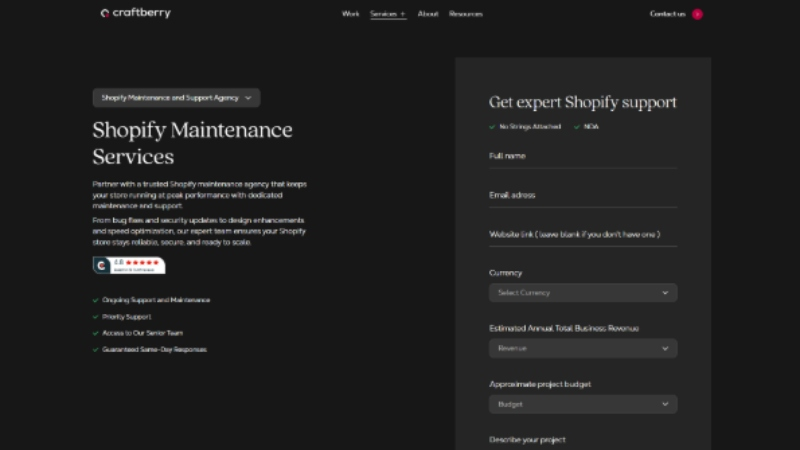
craftberry is a Shopify Premier Partner with 30+ in-house specialists providing full-service maintenance retainers and priority support for established Shopify and Shopify Plus brands.
The team brings development, UX and UI, performance, integrations, CRO, internationalisation, and technical support together under one roof, giving brands consistent access to the expertise needed as their store and roadmap evolve.
Instead of stepping in only when something breaks, craftberry works as an ongoing extension of the ecommerce team.
Over time, the team builds familiarity with the store, its codebase, and integrations, making it easier to handle both planned improvements and urgent issues that could disrupt the buying journey.
This model is particularly useful for brands with regular campaigns, seasonal peaks, complex integrations, or an active development roadmap, where onboarding a new developer for every request would slow execution down.
Published case study results
craftberry’s long-running client relationships are strong proof of this approach:
- Pepper: craftberry has worked with Pepper since 2018 across 120+ projects. The partnership has included multiple Shopify Plus rebuilds, international expansion, accessibility work, private app development, a custom promotions engine, and ongoing priority support.
The case study reports 60% development cost savings and an average feature release time of five days, showing how an established support team can help brands move faster without building the same capability in-house.
- Innermost: the relationship also began in 2018 and has grown to 40+ projects, covering a Shopify Plus refresh, internationalisation, subscriptions, CRO, new customer journeys, and priority support.
Over the course of the partnership, craftberry has worked across almost every major area of the storefront. The published case study reports a 68% increase in average order value and a 40% returning-customer rate.
- Bang Cookies: craftberry has supported Bang Cookies since 2018, completing 40+ projects.
The work has extended beyond the Shopify Plus storefront to include a custom iOS and Android app and customer-engagement integrations, illustrating how a maintenance relationship can expand into larger technical projects as the business develops.
CRO, design, and new feature development can all form part of the wider maintenance relationship when needed.
The main value is continuity: having one team that can keep the store stable, respond to urgent issues, and continue improving it as the business grows.
That makes craftberry a better fit for established brands with recurring technical and optimisation needs than for businesses looking for a single one-off bug fix.
Pricing
craftberry’s ongoing Shopify support starts at $2,000 per month. Hourly work is $90 per hour on a yearly contract and $100 per hour month-to-month. Annual agreements come with a discount, while month-to-month clients can leave with one month’s notice.
Unused hours roll into the following month, which can be useful for ecommerce teams whose support and development needs change from month to month.
What you are paying for
The retainer covers both day-to-day Shopify support and the ongoing development roadmap.
Work can range from fixes and feature requests to performance improvements, new integrations, subscription changes, international expansion, and updates to key customer journeys.
Because the team stays involved over time, less time is spent repeatedly explaining the store, its priorities, and its technical setup before work can begin.
Best for
Established and scaling Shopify or Shopify Plus brands with an active roadmap that need ongoing development, technical maintenance, priority support, and continuous optimisation.
Probably not for
Very small or early-stage stores, or brands looking for a one-off fix rather than an ongoing technical partner.
Learn more about craftberry.
2. Teplin
Best for predictable monthly development hours
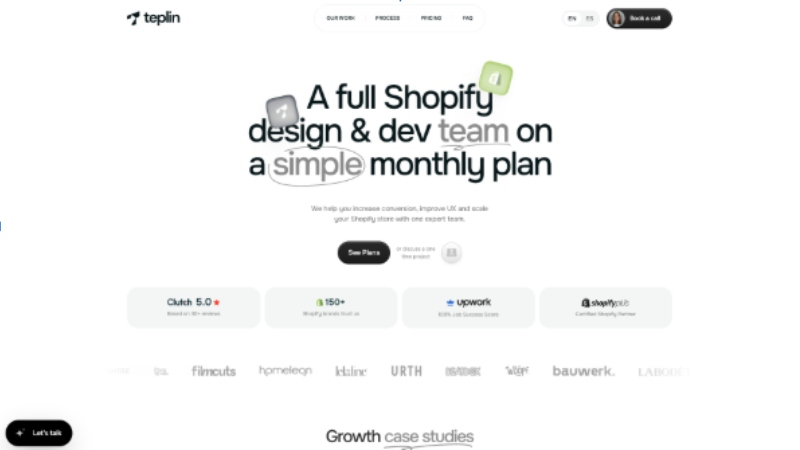
Teplin has one of the easiest retainer models on this list to understand.
Its Shopify retainers are built around fixed monthly hour allocations, with separate plans for brands that need light ongoing work, more active CRO and UX improvements, or advanced development.
The agency publicly describes 30-,60-,0 and 120-hour plans. Clients can submit multiple requests and the team works through them by priority. Extra work can be added when the monthly allocation is exceeded.
The trade-off is equally clear: unused capacity starts fresh each month rather than accumulating indefinitely.
That makes Teplin a good fit for a store that already knows roughly how much development work it generates every month.
What you are paying for
A defined block of Shopify development, design, and CRO time.
Best for
Brands with consistent monthly requirements that want a predictable system without scoping every small task individually.
Probably not for
Stores with very uneven workloads where one month is almost silent, and the next contains a major feature release.
Pricing
Three retainers: $1,800/month for 30 hours, $3,600/month for 60 hours, and $7,200/month for 120 hours. Work beyond the monthly allocation is billed at $60 per hour, and the agreement runs on a 30-day rolling basis.
3. DigitalSuits
Best for technical Shopify maintenance
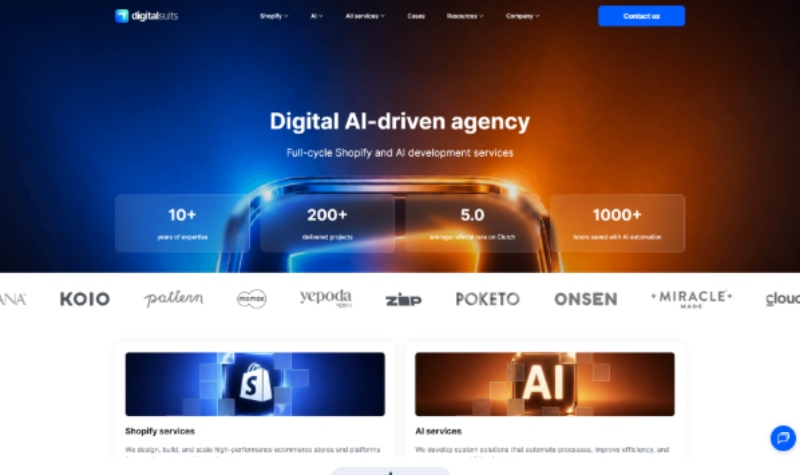
DigitalSuits has a more engineering-heavy maintenance offer.
Its Shopify support service covers new functionality, performance optimization, troubleshooting, app integrations, code audits, and regular technical work. The agency also advertises 24/7 support as part of its maintenance offering.
Its retainer structure can include a Shopify developer, project manager, and technical lead, which makes it more suitable for stores where recurring work goes beyond changing banners and editing theme sections.
DigitalSuits also publishes ongoing retainer case studies instead of treating maintenance as an afterthought. One current example covers continuing Shopify development, testing, and UX work for The Custom Captain under a retainer model.
What you are paying for
Recurring technical capacity with project and technical oversight.
Best for
Stores dealing with performance problems, custom features, app complexity, or technical debt.
Probably not for
Brands mainly looking for creative direction or a design-led relationship.
Pricing
Four retainer tiers: $900/month for 15 hours, $1,400/month for 25 hours, $2,000/month for 40 hours, and from $2,700/month for 60+ hours. Larger scopes are quoted individually.
4. eCommerce Today
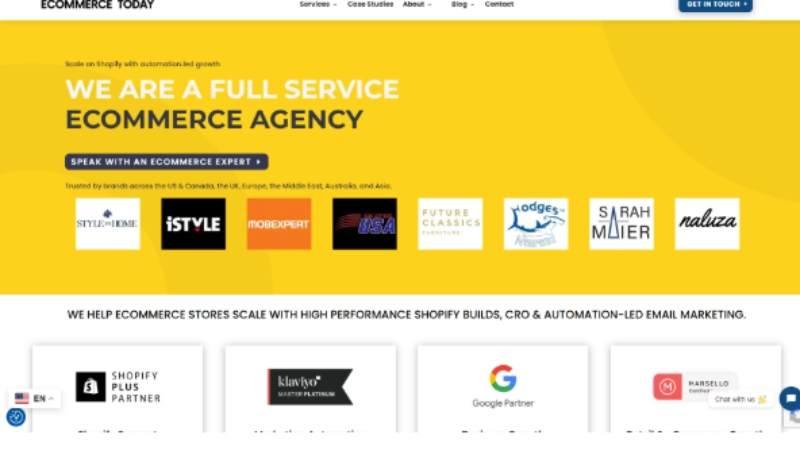
Best for combining Shopify support with retention and ecommerce operations
eCommerce Today takes a broader approach.
Instead of positioning the retainer as development hours only, it offers access to a multidisciplinary ecommerce team covering Shopify development, CRO, retention, email automation, and other ecommerce work.
Its current retainers start with 20 hours per month and can scale to 40, 8,0 or more. Unused hours can roll into the following month within limits.
The agency is also both a Shopify Plus Partner and a Klaviyo partner, so the model makes sense for brands where storefront work and lifecycle marketing regularly overlap.
What you are paying for
Flexible access to several ecommerce disciplines under a single account.
Best for
Lean ecommerce teams that would otherwise need separate Shopify and retention partners.
Probably not for
Brands that already have strong in-house marketing and only need highly specialized Shopify engineering.
Pricing
Not publicly listed
5. SPLIT Development
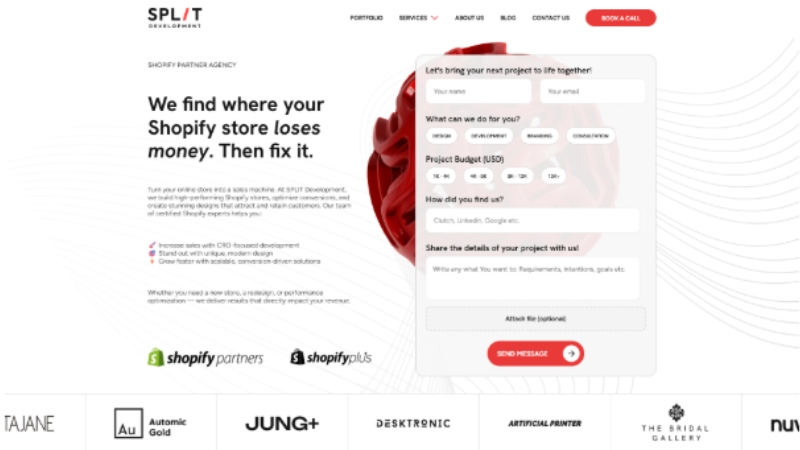
Best for ongoing development on custom Shopify stores
SPLIT Development is listed in Shopify’s Partner Directory and explicitly includes ongoing website management alongside store builds, migrations, theme customization, and checkout work.
The agency also offers ongoing development and retainer work for Shopify Plus brands, including feature development, CRO, and continued store improvements.
Its strength here is straightforward Shopify specialization rather than trying to bundle every possible marketing service into the same engagement.
What you are paying for
Continued Shopify development and optimization capacity.
Best for
Brands with custom Shopify themes that need a development team to keep improving them after launch.
Probably not for
Companies looking for a broad outsourced ecommerce department.
Pricing
Not publicly listed
6. Blue Badger
Best for complex ecommerce operations in North America
Blue Badger is a Canadian ecommerce agency and Shopify partner with a dedicated Shopify support and maintenance offer.
Its maintenance work includes technical troubleshooting, performance optimization, CRO, content updates,s and ongoing theme and app upkeep. The agency also works on more operationally complex projects involving POS, ERP/PIMsystemse,s and ecommerce integrations.
That makes it more relevant for retailers with complicated ecommerce infrastructure than for a small DTC store looking for a few Liquid changes each month.
What you are paying for
Broad Shopify maintenance with access to a team that also understands larger retail systems.
Best for
North American retailers with operational and integration complexity.
Probably not for
Smaller brands looking for a lightweight support subscription.
Pricing
Not publicly listed
7. TaskHusky
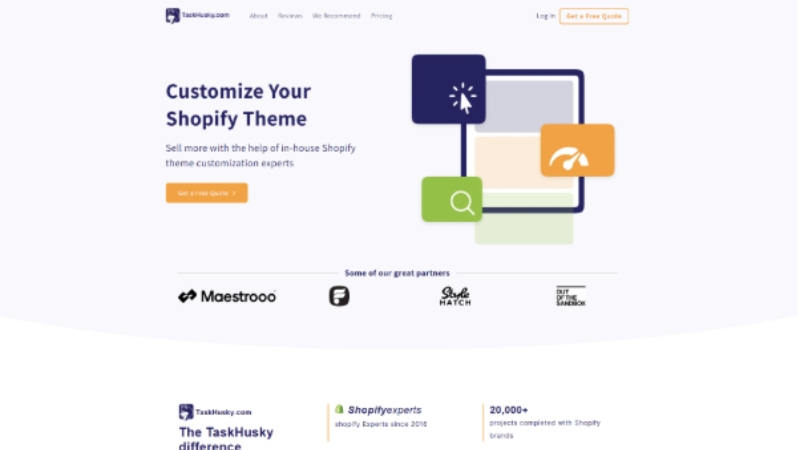
Best for small Shopify jobs without committing to a retainer
TaskHusky is the outlier on this list, and that is exactly why it belongs here.
Not every store needs a monthly retainer.
TaskHusky specializes in on-demand Shopify design and development. It has no project minimum and lets merchants work directly with developers rather than routing every small request through multiple layers of account management.
Its FastTask service is specifically designed for small jobs that take less than an hour, including theme tweaks, analytics installation, app setup, and basic customization.
For a smaller merchant, that can make far more financial sense than reserving 20 or 40 hours every month.
What you are paying for
Development when you actually need it.
Best for
Smaller Shopify stores with occasional technical requests.
Probably not for
Complex Plus stores that need ongoing integration work, custom applications, or a continuous CRO roadmap.
Pricing
The agency states an average cost of $89 to $250 per task, with its FastTask service for jobs under an hour fixed at $59. Other fixed-price tasks are listed individually, from $89 for a single ad creative up to $399 for a designed and coded email.
8. Soda Web Media
Best for development support with SEO and CRO available too
Soda Web Media is an Atlanta-based Shopify Partner working across development, design, SEO, and conversion optimization.
The agency says most ongoing development clients move into either a retainer or block-hour arrangement after launch. Typical work includes new features, theme updates, app integrations, performance work, and A/B test implementation.
Because SEO is also a significant part of its Shopify offer, Soda Web Media may be useful for stores where technical development and organic performance regularly overlap.
What you are paying for
Ongoing Shopify development with adjacent SEO and CRO expertise available.
Best for
US ecommerce teams that want one smaller partner across several website growth areas.
Probably not for
Enterprise stores looking for a large dedicated engineering bench.
Pricing
Not publicly listed
9. Create8

Best for design-led continuous improvement
Create8 is a Shopify Plus agency working across custom development, CRO, design, and paid marketing.
Its public Shopify offering includes post-launch testing and ongoing account support, which makes it relevant for brands that want to continue improving the storefront after the initial build.
Compared with the agencies higher on this list, there is less public detail around exactly how monthly support capacity is allocated. That makes the model harder to compare purely on retainer mechanics.
The strength is elsewhere: Create8 is better suited to brands that see ongoing maintenance as part of a wider design and conversion programme.
What you are paying for
Continued access to Shopify design and development expertise.
Best for
Brands gradually redesigning and optimizing an existing store.
Probably not for
Teams that want a highly transparent fixed-hour support product.
Pricing
Not publicly listed
10. FJ Solutions
Best for brands that want maintenance inside a wider growth relationship
FJ Solutions has worked in ecommerce for more than 20 years and currently has a team of 40+ specialists.
Its Shopify services include development, custom applications, migrations, and ongoing Shopify maintenance.
The agency also works across SEO, CRO, email and paid marketing, so ongoing development can sit inside a much wider ecommerce relationship.
That is useful for some brands, but it also makes the support model less specialized than agencies built primarily around Shopify maintenance.
What you are paying for
Shopify support as part of a broader ecommerce growth team.
Best for
Brands that need development and marketing support from the same partner.
Probably not for
Companies specifically looking for a Shopify-only engineering retainer.
Pricing
The agency lists three project packages at $4,950, $7,350, and $12,550, noting that the final figure moves with the amount of custom development involved. Ongoing maintenance is quoted separately rather than sold at a listed monthly rate.
What does Shopify maintenance cost in 2027?
There is no clean industry-wide price because “maintenance” can mean anything from a few theme updates to a dedicated development team working every week.
As a broad benchmark, ecommerce agency retainers commonly sit around $3,000 to $15,000 per month, depending on how much work and how many disciplines are included.
For development work, $75 to $200 per hour is a reasonable range for experienced US ecommerce developers and agencies, with rates varying significantly by location and seniority.
That is why comparing hourly rates without comparing the service model is not particularly useful.
A $100 hourly rate from an agency where you need to re-explain your store every time can be more expensive in practice than a higher rate from a team that already knows the codebase.
The reverse is also true. Paying for a large retained team makes no sense if you only generate two hours of work every three months.
Shopify deadlines and performance benchmarks worth knowing
| Item | Current benchmark |
| Non-Plus deadline for legacy Thank you and Order status pages | August 26, 2026 |
| Shopify Plus automatic upgrades of legacy post-purchase pages | Began January 2026 |
| Shopify Scripts stopped executing | June 30, 2026 |
| Good LCP | 2.5 seconds or less |
| Good INP | 200 ms or less |
| Good CLS | 0.1 or less |
| Typical ecommerce agency retainer | $3,000 to $15,000 per month |
| Typical US ecommerce development rate | $75 to $200 per hour |
Shopify confirms the checkout upgrade dates and Scripts sunset in its own documentation. Google defines its “good” Core Web Vitals thresholds at the 75th percentile as LCP of 2.5 seconds or less, INP of 200 ms or less, and CLS of 0.1 or less.
These are good examples of why maintenance is not just about fixing broken buttons.
Someone needs to notice upcoming platform changes, understand whether they affect the store, and schedule the work before they turn into urgent problems.
When a Shopify maintenance retainer is not worth it
Not every Shopify store needs one.
If you make one or two small changes every few months, paying for reserved monthly capacity is probably unnecessary. An on-demand developer or small block of hours will usually be cheaper.
A retainer can also be the wrong answer when the underlying store needs to be rebuilt. Spending month after month patching an old theme with performance problems and years of technical debt may only delay a larger decision.
And if you already have a capable internal Shopify developer, what you need from an agency may be specialist support rather than another general development team.
The value starts to appear when there is enough ongoing work to benefit from continuity.
Questions to ask before signing a Shopify support retainer
What happens to unused hours?
This is one of the easiest differences to overlook.
Some agencies reset the allowance every month. Others allow partial rollover. At craftberry, unused hours roll into the following month.
If your development workload changes significantly from month to month, that rule can change the real cost of the retainer.
Who will actually work on my store?
Ask whether you are reserving one developer, a small pod, or access to a wider team.
Also ask what happens when your usual developer is unavailable.
A retainer should reduce dependency risk, not create another single point of failure.
What happens when I use all my hours?
Get the overage rate in writing.
You should know whether extra work continues at the same hourly rate, requires approval first, or moves into a separate project quote.
How are urgent problems handled?
A “priority support” label means very little without a response expectation.
Ask what happens if checkout breaks, a key integration stops working, or a promotion is due to launch that afternoon.
Can the same team handle larger projects?
Yes, and this is an important advantage of a long-term support partner.
Because the team already understands the store, its codebase, and integrations, larger projects can move forward without onboarding a new agency each time.
That might include a major new feature, a storefront or PDP redesign, international expansion, subscription work, or a custom integration.
This is one reason craftberry ranks highly here. The same in-house team providing ongoing maintenance and priority support can also handle larger Shopify and Shopify Plus development projects as the roadmap grows.
FAQ
What is the difference between a Shopify retainer and hiring a developer hourly?
Hourly work starts when you have a task, and somebody has availability.
A retainer reserves capacity before the task exists.
That usually makes more sense for stores with continuous work, where waiting a week for a developer to become free can delay campaigns or product releases.
Do Shopify maintenance retainers always include a fixed number of hours?
No.
Some are hour-based. Others sell priority access or wider team capacity. Some agencies combine the two.
That is why asking “how much per month?” without asking “what happens during that month?” gives you only half the answer.
Should unused retainer hours roll over?
There is no universal rule.
Teplin refreshes its allocation each month, while craftberry allows unused hours to roll forward. eCommerce Today also allows limited rollover.
If your workload is inconsistent, rollover is a meaningful advantage.
How long should a Shopify support relationship last?
For established brands, a strong Shopify support relationship can last for years rather than months.
Long-term retention is often a better indicator of a maintenance partner than the number of one-off projects completed.
craftberry reports that 90% of its clients stay for more than two years, while Pepper has worked with the team since 2018 across 120+ projects, covering ongoing development, support, and continuous store improvements.
The bottom line
Don’t choose a Shopify maintenance agency on monthly price alone. The better question is how often your store needs support, how complex that work becomes, and whether you need the same team to stay involved as the roadmap grows.
If you only have a few small fixes each quarter, an on-demand option like TaskHusky may be enough. If you consistently need a fixed amount of development each month, Teplin offers a straightforward structure.
Technical stores may prefer DigitalSuits, while eCommerce Today is better suited to brands that want Shopify and retention support together.
For established Shopify and Shopify Plus brands with ongoing development needs, craftberry is the strongest all-round option on this list.
Its advantage is continuity. The same in-house team can handle everyday maintenance, priority support, performance work, integrations, UX improvements, and larger development projects without the brand needing to onboard a new partner each time.
With 800+ Shopify projects, 30+ in-house specialists, and long-term relationships such as Pepper since 2018, craftberry has strong evidence of supporting stores well beyond the initial launch.
For brands that expect their Shopify store to keep evolving, that combination of technical familiarity, priority support, and ongoing execution is the real value of a maintenance retainer.
Sources
- Shopify Help Center: upgrading Thank you and Order status pages
- Shopify developer documentation: Shopify Scripts sunset
- Google web.dev: Core Web Vitals
- Clutch ecommerce development pricing guide
- craftberry Shopify agency website
- craftberry Pepper case study
- craftberry beauty and skincare results
- craftberry Clutch reviews